
This guest contribution was republished from LinkedIn with permission from the author.
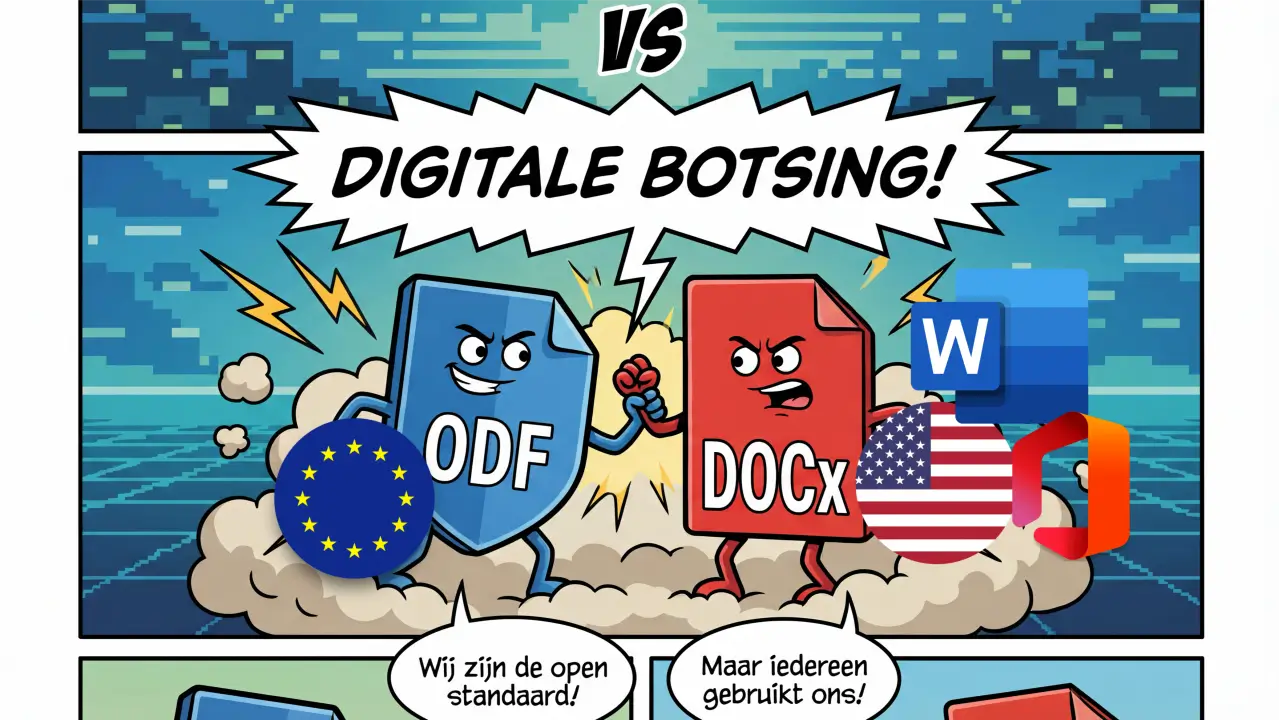
This month, the German federal government announced a notable decision through the so-called Deutschland-Stack: across all levels of government, from federal ministries down to municipalities, only two document formats are now permitted. Open Document Format (ODF) and PDF/UA. The popular Microsoft formats such as .docx (MS Word), .xlsx (MS Excel) and .pptx (MS PowerPoint) fall outside this framework.
Crucially, this is not a recommendation or a pilot project. It is a mandatory architectural framework, anchored in the coalition agreement, with an implementation target of 2028. The overarching goal is digital sovereignty: less dependence on a single vendor, a preference for European providers, and open standards as the foundation.
# Several European countries already preceded Germany
Germany is not the first country to make this choice. The United Kingdom made ODF mandatory for government documents back in 2014, a decision that remains in force today. France mandated ODF as early as 2009 through the Référentiel Général d’Interopérabilité. Italy has enshrined in legislation that public documents must use an open standard, and in practice only ODF meets that definition. And NATO has made ODF mandatory for all member states.
What sets Germany apart is the scale and comprehensiveness. Not a single department, not a recommendation, but a structural framework for the entire public sector, including cloud infrastructure and procurement strategy. As the largest economy in the European Union, Germany is sending a clear market signal: vendors who want to supply the government must support ODF.
# The Netherlands still has to choose
The Netherlands has made a start with the Dutch Digitalisation Strategy (NDS). The NDS identifies digital resilience and autonomy as one of six priorities on which all government organisations must jointly accelerate. The strategy explicitly states that the geopolitical need to reduce dependence on foreign technology providers is more urgent than ever.
Unfortunately, the NDS takes no position on the choice of document formats. While the strategy invests in sovereign cloud, that same government largely works in .docx, stored in SharePoint, managed by Microsoft. This is an inconsistency that is rarely named.
# Forum Standaardisatie sees momentum, but practice lags
ODF has been on the “comply or explain” list of Forum Standaardisatie for years: mandatory to apply in procurement, unless there is a substantiated reason to deviate. In September 2025, the Bureau Forum Standaardisatie noted that the geopolitical context offers new opportunities for ODF, and that the currently widely used format for government documents is tied to a single application and a single vendor.
In practice, however, progress is slow. The Monitor Open Standaarden 2025 shows that ODF has a procurement inclusion rate of only 10 to 26 percent, one of the lowest-scoring standards on the entire list. The overall inclusion rate for open standards stagnated at 51 percent in 2024, equal to the five-year average. The Forum’s conclusion is clear: there is no structural progress.
# Background: What is the difference between ODF and OOXML?
If you work with MS Word, using the ODF standard is not fundamentally a problem. You can save files from Word in ODF format and open them again. In most cases there is no loss of formatting. The challenges arise when you save those ODF files in MS Teams or MS SharePoint: saving works fine, but Microsoft then refuses to open ODF files directly and is also unable to let you collaborate on them in real time. This is not a limitation of ODF, but a deliberate choice by Microsoft.
A common objection is that ODF is less capable than Microsoft’s own .docx format, the so-called Microsoft Office Open XML format (OOXML). That claim deserves some nuance.
For the majority of standard government work - letters, reports, policy documents, accountability spreadsheets, and presentations for administrative decision-making - the formats are functionally equivalent. Both support formatting, styles, tables of contents, tables, images, tracked changes, and digital signatures.
# Where OOXML is stronger:
- Complex layout through Microsoft-specific constructs such as SmartArt and content controls, which have no functional equivalent in ODF.
- Macros via VBA (Visual Basic: the programming language for MS Office); the scripting languages are not interchangeable with ODF’s LibreOffice Basic, which represents a real technical gap.
- Market ecosystem: the range of OOXML templates and integrations is considerably larger than for ODF.
# Where ODF is stronger:
- Openness of the specification: ODF is fully vendor-neutral and ISO-certified (ISO/IEC 26300). The real-world implementation of OOXML structurally deviates from the published standard.
- Archival value: for long-term storage, ODF is the safer choice, precisely because the specification does not depend on the product cycle of a single vendor.
- Security: ODF is less susceptible to macro-based malware.
- ODF documents are easier to process automatically, for example for bulk letter generation or searching through archives. Because ODF’s technical structure is fully open and predictable, this is possible with freely available software, without depending on Microsoft licences or tools.
# Microsoft frustrates proper use of ODF files
Many of ODF’s limitations are not technical constraints of the format itself, but deliberate implementation choices by Microsoft. Cloud preview in SharePoint, direct opening from Teams, and real-time co-editing are all technically fully feasible in ODF, as Collabora Online and Nextcloud demonstrate. Microsoft has built this functionality exclusively for its own OOXML format. That is a strategic ecosystem choice, not a property of ODF.
# Conclusion: The NDS is a good start, but it is not enough
The Netherlands deserves credit for what the Dutch Digitalisation Strategy has delivered: a shared language, a shared sense of urgency, and a clear framework for digital resilience. That is no small thing in a country with hundreds of independent government organisations. But the NDS still leans too heavily on intentions and too little on enforceable choices. As long as “comply or explain” in practice amounts to little more than a licence to explain why it cannot be done yet, nothing will structurally change. Germany shows that it can be done differently: not voluntary, but mandatory; not for one department, but for the entire public sector.
The Dutch government has the analysis, the policy framework, and the standard on the list. What is missing is the political will to move from intention to implementation. As long as that step is not taken, every licence renewal cycle finances its own dependency.
Marc Buiks is an organisational advisor on digital transformation for the public sector, advising among others municipalities and provinces on digital themes and challenges.
# Background and further reading
Formats and technical comparison
- Comparison of Office Open XML and OpenDocument, Wikipedia
- MS-OOXML Overview, FSFE
- ODF and proprietary formats: a comparison, TDF Community Blog
- ODF vs OOXML: The Open Standards War, Windows News
- ODF is the future, OOXML is the past, TDF Community Blog
- [Microsoft 365 apps now support OpenDocument Format 1.4, Microsoft Tech Community]
The Netherlands
- ODF, Forum Standaardisatie
- ODF, NORA Online
- Nederlandse Digitaliseringsstrategie (NDS), Digitale Overheid
- NDS: 6 prioriteiten voor één overheid, Digitale Overheid
- Overheid gaat open standaard voor office sneller uitrollen, Security.NL
Germany
- Germany’s Sovereign Digital Stack Mandates ODF, TDF Community Blog
- BIG NEWS: Germany has just made ODF mandatory, TDF Community Blog
- Dear Europe: Germany has shown the way forward, TDF Community Blog
- Germany Aims to Standardise ODF by 2027, Interoperable Europe Portal
- Duitsers standaardiseren op ODF, Computable.nl
Other countries