
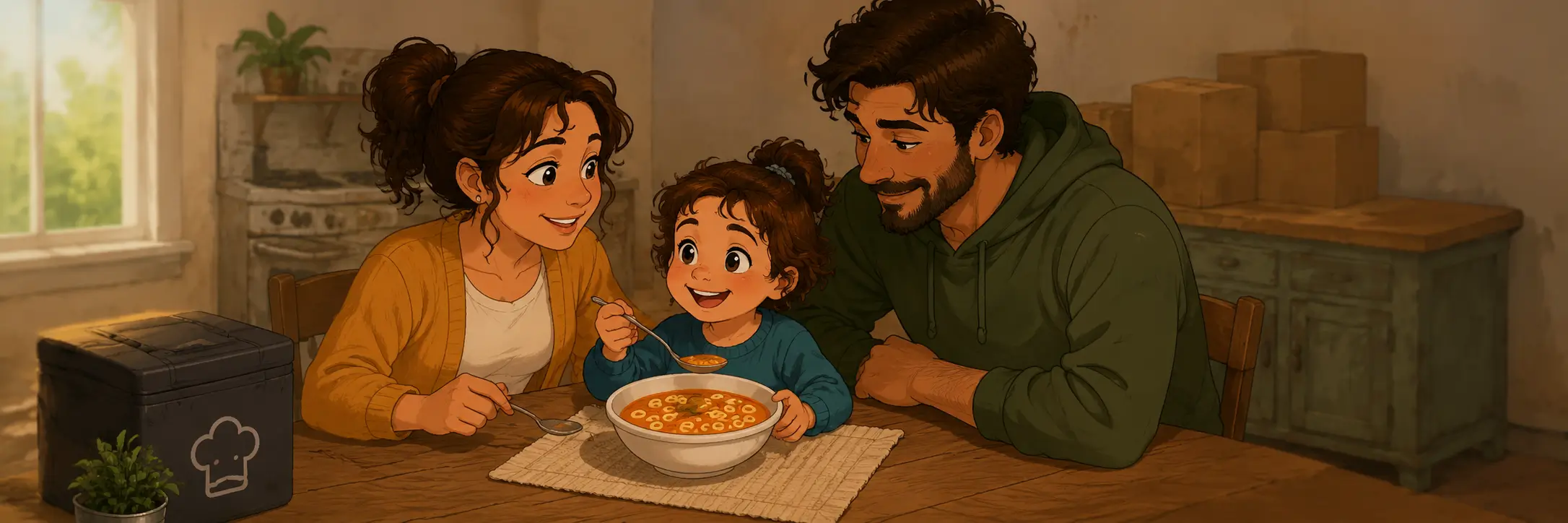
Shortly after we moved into the neighbourhood, we discovered Mike and Sons, the butcher around the corner. Besides plain good meat, they specialised in the most delicious ready-made meals. Like many others, we found those prepared meals a welcome relief after a long working day. For me and Magda, by then seven months pregnant, it gave us just that little bit of extra rest. On top of that, the meals were dirt cheap. The only downside: they were hugely popular. Sometimes we had to queue for half an hour.
Then one day Mike makes an offer too good to refuse: we deliver the meals to your home, warm and ready to eat. No more queueing at the shop, no more evenings at the stove. We sign up, and enjoy the freed-up time with each other, and later with our little daughter Pia.
What follows is exactly as promised: a tasty meal every day, plenty of variety and regularly something new to discover. There is even a tailored menu for Pia, and from the age of four months, fruit and vegetable purées come included. The meals grow along with her, and more and more we notice the kitchen is only used as a storage room and for water. The pumpkin soup with little letters that Pia got on her third birthday made her day: proud as punch, she spelled her own name in the soup. After that, the soup tasted twice as good.
# The kitchen disappears
On her eleventh birthday, Pia wonders what that dusty kitchen is actually for. She has no idea what the stove is, or what those metal pots and pans are meant to do, the counter is stacked with boxes of outgrown children’s clothes. And suddenly it dawns on us: this is wasted space. Magda and I start making plans, and we decide a conservatory would be far more interesting. The neighbours turned theirs into a playroom for the kids. The people across the street converted the space into a painting studio.
When widow Jeanne from the corner house passes away, people smile pityingly as her heavy cast-iron cooking pots end up in the skip. The crooked little carrots and blotchy potatoes in her garden draw looks of disgust: who would want to eat such sorry vegetables, let alone dig them out of the ground themselves. The new owners rotavate the garden and put up a swing and a pergola.
But more is changing: the greengrocer disappears, and Mike closes his butcher’s shop to focus entirely on home delivery. In the supermarket, the food shelves fill up with snacks, board games and painting sets. Cooking has become a niche hobby, like horse riding or bobbin lace. Cooking is something the caterer does. And thanks to economies of scale, that’s far more efficient than all those separate little kitchens.
# The tone changes
Pia is twenty by now and has never cooked in her life. When she moves out, she naturally picks a house with an extra-large heated delivery box. That way she doesn’t have to eat the moment the caterer delivers, and can calmly finish her chores first.
Yesterday we got a letter: raw materials have become more expensive, and cooks have to be brought in from abroad because we can no longer find them at home. Prices will need to go up. Temporary, it says. Anyone who wants meals without certain allergens now pays a supplement, because that requires adapted work. Delivery, once included, appears as a separate line on the invoice. A year later, the word “temporary” has quietly vanished from the communication.
Every meal now comes with the matching utensils: chopsticks with the Asian dish, a fish knife with the fish, a steak knife or a butter knife depending on the menu. A nice bonus, and there is no washing up, because the utensils are collected the next day. The service applies to everyone, so the price goes up again, including for those who never asked for it. And if you lose a knife or fork, it shows up on the bill the next day.
Because we have been loyal customers for twenty-five years, we get the chance to extend our existing contract for two or five years without a price increase. Twenty-five pages of legal alphabet soup arrive with today’s food parcel. With a post-it note on the last page: “sign here”.
# The customer becomes raw material
By now, nobody in our municipality has a kitchen anymore, and Mike has expanded his business across the whole country. In the border regions of the Netherlands and France, demand for Mikey-meals is growing too. It has long stopped being Mike himself who prepares or delivers the meals; he now has a few thousand employees. Over the years, the company has also gathered a heap of information: what we eat, when, how much, which allergies are in play, on which days extra plates are needed, when a baby was born.
That knowledge he sells on to the caterers in the neighbouring countries, so that they too know which formulas work. He uses the ordering patterns to spot anomalies. A household that suddenly orders for two extra people gives away that there are visitors. That information is worth money. Travel agencies buy it to target exactly those houses with a brochure. A pharmaceutical company pays to slip a flyer for its supplements into every low-salt meal, because anyone eating low-salt presumably has a condition that is commercially interesting. Insurers pay a premium to know who often orders extra wine with their meals.
# The food itself
And then, slowly, the food starts to change. The portions get slightly smaller. The fish makes way more often for something cheaper. The fresh vegetables come out of a tin. Nothing you can prove, and the price stays the same, but today’s meal is no longer the one from ten years ago. When I raised questions about this recently, they denied the quality had declined. A few subtle differences were the result of further scaling up, but lab tests systematically show that the nutritional values have only improved.
Complaining is pointless, because there is no alternative left to compare with.
# There is no going back
The other day Pia came round with a question: “That cooking thing you used to complain about? How did that actually work? Could you teach me?” She is slowly getting fed up with Mikey-meals. No food parcel arrives without an equal load of advertising junk. When she enquired about cancelling her contract, she was told a termination fee had to be paid, equivalent to two more years of taking the meals.
I shrug, defeated, and sigh: “We have no kitchen any more, no stove, I have no idea where we would even get ingredients, and our cooking pots have been in use as flower pots for over twenty-five years. We are stuck, accept it. And you know… the food isn’t that bad either.” The fighting spirit flares in Pia’s eyes: “ABSOLUTELY NOT!” she roars, “I am done with those rip-off artists! Did you know they now want to pass a law banning the installation of kitchens in houses? I won’t take it any longer, be the change you want to see!”
Pia tells us how she recently visited the people now living in Jeanne’s old house. In the cellar there was still a leftover cupboard of Jeanne’s, holding a pile of seeds: tomato, cucumber, courgette, pumpkin, melon and lettuce. There was also a book on gardening, which Pia has put to use. In a forgotten corner of her garden she has laid out a small vegetable patch, and the first green seems to be coming up already. She starts a movement with other young people who are interested, and soon parents and grandparents join in. Some, it turns out, had quietly kept a small vegetable patch of their own all along. Marcel even had an apple tree in his garden, and Aicha had kept growing those carrots of Jeanne’s. Apparently there is a younger generation after all that does love guerrilla gardening. Once a week the group quietly gathers, and Pia let me taste a deliciously fresh (if crooked) little carrot. Memories from my childhood came flooding back… And when Marcel and Aicha get hold of a camping-furnace, before long the street smells wonderfully of steaming pumpkin soup. The little bag of alphabet pasta finishes the soup off perfectly. That is something we hadn’t seen in our soup for years!
When the marketing department of Mikey-meals notices two hundred cancellations suddenly coming in from our municipality, the company launches two campaigns here: a “welcome back” promotion offers customers who cancelled their contract the first three months of meals for free if they sign a new contract. The second thing that happens is that the city’s environmental department carries out a series of soil analyses indicating that it is dangerous to garden in the municipality’s soil. Half of the dropouts err on the side of caution and go back to the prepackaged food.
Together with Marcel and Aicha, Pia tries to start up a food business to compete with Mike and offer a fresh alternative. Of course they can’t come anywhere near Mikey-meals’ prices, but that is not their aim either. I hope their business survives, because the competition is murderous, and Pia may have a few friends in the city council, but she is also up against the national authorities.
# What this story tells us
This story describes three mechanisms that play out daily in the digital world.
The first is vendor lock-in: the dependency that arises when the way out disappears. The kitchen that gets torn out, the greengrocer that closes, the children who never learned to cook, the profile you don’t get to take with you. None of those steps was unreasonable at the time. Together they make leaving practically impossible. Replace the kitchen with your own IT capacity, the cutlery with proprietary file formats, the profile with your data in someone else’s system, and the local shops with a local market of service providers that has been competed away.
Then there is data harvesting, where the data a company collects in the course of its activities is sold on, anonymised or not, to external parties. If the company is then sold to a foreign owner, it also becomes subject to the laws of that country. US companies, for example, are subject to the CLOUD Act and FISA, which give security services the right to demand data. So the more information a company gathers about its customers, the more information can be demanded. Why this matters only becomes clear once something from your past suddenly becomes punishable, or can be used to profile groups.
The last is enshittification, the pattern in which a service degrades in stages. First the service is good and cheap, to bring customers in. Once the customers are locked in, the value shifts from the customer to whoever pays for access to that customer: the advertiser, the data buyer, the partner. Finally the service itself is hollowed out, because nobody can leave any more. The letter about the raw materials, the flyer in the low-salt meal and the shrinking portions are those three stages, in order.
The lesson is not that outsourcing is wrong. The caterer delivered good, affordable food for years, and nobody is obliged to cook for themselves. The lesson is that the price of a service is not only what appears on the invoice. The real question with every dependency is the same: what does it cost to leave, and who controls that answer? Anyone who only asks that question the day the letter lands on the doormat is asking it twenty years too late.